Advanced Techniques for Mixing Vibrant Landscapes: Oil Painting Tips
Introduction
A great landscape painting isn't just about copying the scene; it's about interpreting light and space. Advanced landscape painting requires moving beyond "sky is blue, grass is green" to understanding atmospheric perspective, chromatic grays, and the subtle temperature shifts that create vibration on the canvas. This guide focuses on professional mixing recipes and optical tricks to bring your landscapes to life.
The Professional Landscape Palette
While a basic split-primary palette works, professional landscape painters often add specific "power colors" to speed up mixing and achieve cleaner results:
- Transparent Oxide Red (or Burnt Sienna): Essential for glowing darks and warming up greens.
- Viridian (or Phthalo Green): A high-chroma transparent green. Never use it pure! It's a mixer.
- Cobalt Blue: The perfect "sky blue" – cooler than Ultramarine but not as aggressive as Phthalo.
- Cadmium Orange: A secret weapon for neutralizing blues to make grey clouds.
- Yellow Ochre: The base for all sunlit grass and distant fields.
Mastering Atmospheric Perspective
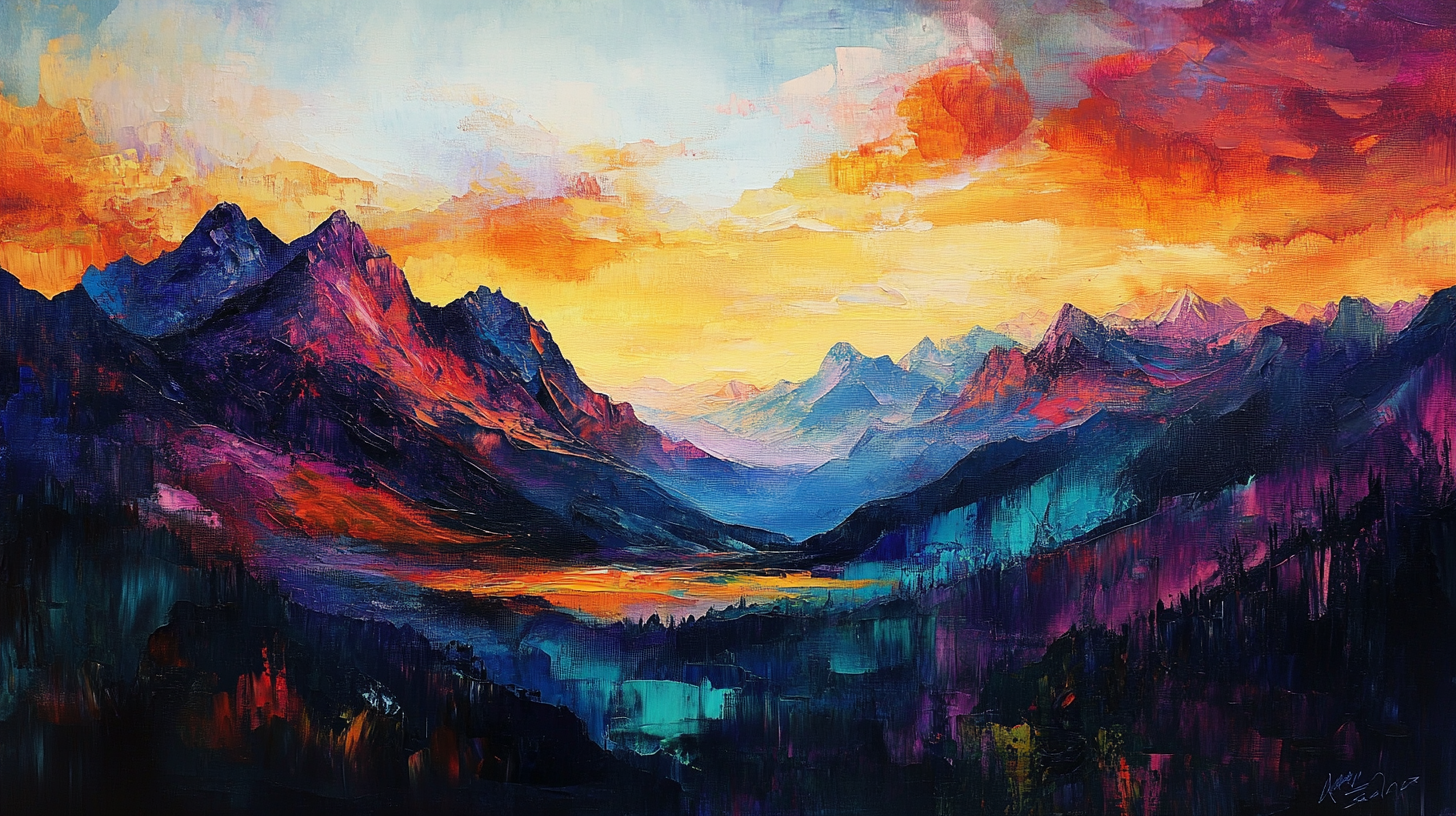
Atmospheric perspective is the single most important concept for depth. As objects recede, particles in the air scatter light, causing three specific shifts:
- Value gets lighter: Distant shadows are not black; they are light blue-grey.
- Temperature gets cooler: A warm green tree becomes a cool blue-green haze in the distance.
- Saturation drops: Colors lose their intensity.
Mixing Recipe for Distant Mountains
Do not just use blue + white. It looks chalky.
Try this: Cobalt Blue + Titanium White + a tiny touch of Orange (or Burnt Sienna).
The orange neutralizes the blue slightly, pushing it back in space. If it looks too purple, add a dot of Viridian.
The Secret to Realistic Greens
Tube greens (like Sap Green or Hooker's Green) often look artificial if used straight. In nature, greens are muted.
The "Desaturation" Trick
To make a green look natural, you must add its complement: Red.
- Olive Green: Mix Ultramarine Blue + Cadmium Yellow. It will look electric. Now, add a touch of Alizarin Crimson or Cadmium Red. Watch it settle into a rich, natural olive.
- Sunlit Grass: Cadmium Yellow (or Hansa Yellow) + a tiny touch of Green. Then add White and Yellow Ochre. The ochre gives it "body," so it doesn't look like neon acid.
- Deep Shadow Green: Ultramarine Blue + Transparent Red Oxide (Burnt Sienna). This creates a near-black. Add a little Viridian to pull it towards green. This is far superior to using black paint.
Luminous Sky Recipes
The sky is a dome, and its color shifts from the horizon to the zenith (overhead).
The Zenith (Deepest Blue)
Recipe: Ultramarine Blue + a little White. Ultramarine is a violet-blue, which helps it feel deep and overhead.
The Mid-Sky
Recipe: Cobalt Blue + White. As you move down, transition to Cobalt, which is a true neutral blue.
The Horizon (Warmest/Lightest)
Recipe: Cerulean Blue (or Phthalo Blue trace) + lots of White + a tiny speck of Naples Yellow or Cadmium Orange.
Expert Tip: The horizon is often slightly greenish or teal due to the yellow light of the atmosphere mixing with the blue sky.
Cloud Shadows
Clouds are not white cotton balls. Their shadows are rich greys.
Mix: Ultramarine Blue + Burnt Orange + White. This makes a pearlescent neutral grey that reflects the light beautifully.
Vibration and Contrast
Color Vibration is an advanced technique where you place two colors of the same value but different temperatures side-by-side.
Example: In a green field, place strokes of a reddish-grey (same darkness as the green) next to the green strokes. From a distance, the eye blends them, creating a "vibrating" effect that mimics the shimmering light of nature.
The "Darkest Dark" Rule
Save your darkest darks for the immediate foreground shadows. Do not put pure black/dark in the distance. This anchor keeps the viewer's eye in the painting.
Recipe for Rich Black: Alizarin Crimson + Phthalo Green. This makes a chromatic black that is much deeper and more interesting than tube Ivory Black.
Final Thought: Use larger brushes than you are comfortable with. A landscape often fails because of "pecking" – too many small, disconnected details. Block in the big shapes of light and shadow first.
If you have a reference photo and are struggling to identify the exact color of a distant hill or a specific shadow, use our color to oil paint converter. It can analyze the pixels and tell you exactly which tubes to mix to hit that specific value and hue.
Common Mistakes
- Blue Shadows Everywhere: Don't just add blue to make a shadow. Shadows on a red barn are dark red/purple, not blue. Shadows on green grass are dark green/blue-green.
- White in Shadows: Avoid adding white to shadow mixtures if possible. White cools and opaques the color, killing the luminosity. Keep shadows transparent.
- Horizon Line too Sharp: The horizon is almost always soft due to atmosphere. Blur the edge where land meets sky.